
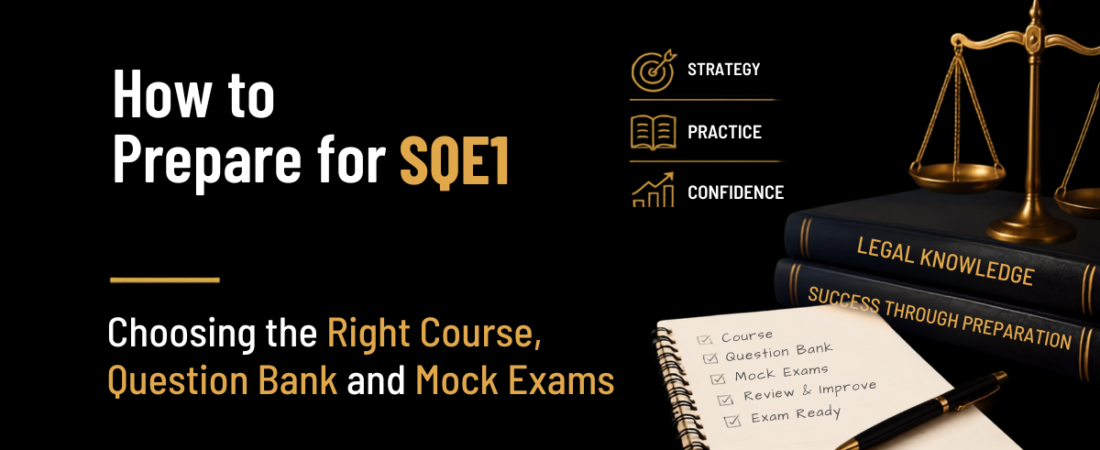
How should you prepare for SQE1? Choosing the right preparation course is important, but it is only one part of an effective SQE1 preparation strategy.
You also need to consider how you will build your legal knowledge, practise applying the law through multiple-choice questions, identify weaknesses and prepare to perform accurately under timed exam conditions.
Candidates often spend hours comparing courses:
- Which provider has the best textbooks?
- Which has the most comprehensive video lectures?
- Which has the largest SQE1 question bank?
- Which offers the most difficult mock exams?
- Which course gives the best value for money?
These are sensible questions. The quality of your study materials matters.
But there is another question that is just as important:
How will your preparation help you perform when you actually sit SQE1?
A preparation course is ultimately a means to an end. Whether you study with BARBRI, QLTS School, The University of Law (ULaw), BPP University, The College of Legal Practice (COLP), or independently, the objective is the same: to prepare yourself to answer SQE1 questions accurately and efficiently under exam conditions.
What Does SQE1 Actually Require?
SQE1 is not simply a test of whether you can remember legal rules.
Candidates are presented with single best answer (SBA) multiple-choice questions based on factual scenarios. You must analyse the facts, identify the relevant legal principles and select the best answer from five options. The SRA explains why SQE1 uses the single best answer format and how these questions are designed to assess the application of legal knowledge.
This creates a challenge that is different from simply reading a textbook or memorising notes.
You may know the relevant legal rule but still choose the wrong answer because you:
- overlook an important fact;
- apply the wrong exception;
- confuse two closely related legal principles;
- choose an answer that is legally true but does not answer the particular question asked; or
- spend too long deciding between two plausible options.
This is why effective SQE1 preparation normally needs to develop both legal knowledge and the ability to apply that knowledge through MCQs. I discuss this distinction in more detail in Why Knowing the Law Is Not Enough to Pass SQE1.
Building an Effective SQE1 Preparation Strategy
The resources that are most useful at the beginning of your SQE1 preparation may not be the resources you need towards the end.
During the early stages, your priority may be building or refreshing your knowledge across the FLK1 and FLK2 subjects.
At this stage, comprehensive textbooks, lectures, revision notes and a structured study timetable can be particularly valuable.
As your knowledge becomes stronger, however, preparation should increasingly involve active practice.
You need opportunities to retrieve legal principles from memory, apply them to unfamiliar scenarios and make decisions without immediately checking your notes. Even a small amount of regular practice can help build this habit. I discuss this approach in One Legal Question a Day: A Small Way to Keep SQE1 Knowledge Fresh.
Closer to the assessment, full-length SQE1 mock exams become increasingly important because they test something that individual practice questions cannot fully reproduce: sustained performance under time pressure.
A candidate who can answer ten MCQs accurately at home may find the experience very different when answering a long sequence of questions against the clock.
How to Choose an SQE1 Question Bank
The size of a provider’s question bank is understandably attractive.
If one course offers 1,000 questions and another offers 3,000, it is tempting to assume that 3,000 must provide better preparation.
But quantity is only one consideration.
A useful SQE1 question bank should expose you to different legal issues, different factual patterns and plausible distractors. The explanations should also help you understand why one answer is better than the alternatives.
Most importantly, you should learn from the questions you get wrong.
Completing thousands of MCQs without analysing your mistakes can easily become a numbers exercise.
For example, after getting a question wrong, consider whether the problem was:
Knowledge: You did not know or remember the relevant legal rule.
Application: You knew the rule but applied it incorrectly to the facts.
Reading: You overlooked a word or fact that affected the answer.
Question technique: You misunderstood what the question was asking.
Time management: You rushed because you had spent too much time on earlier questions. Different problems require different solutions. Doing another 500 questions will not necessarily fix a weakness if you have not identified what that weakness is.
Should You Rely on One SQE1 Preparation Provider?
One point sometimes overlooked in discussions about the best SQE1 preparation course is that you do not necessarily have to obtain every resource from the same provider.
Different providers have different strengths. If you are still deciding between courses, you can also read my comparison of the main SQE1 preparation providers, including BARBRI, QLTS School, ULaw, BPP and COLP.
For example, a candidate might use BARBRI for a structured study programme but supplement it with additional MCQs or mock examinations during final revision.
Another candidate might choose QLTS School because he or she wants extensive question practice, while consulting textbooks or other resources when a topic requires further explanation.
A candidate with a strong legal background may decide that a complete preparation course is unnecessary and instead combine textbooks, revision materials, practice questions and independent mock examinations.
There is nothing inherently wrong with this approach.
In fact, for some candidates, building a combination of resources around their individual weaknesses may make more sense than searching for one provider that is supposedly the best at everything.
Should You Use More Than One SQE1 Question Bank?
There can also be advantages to practising questions from more than one source.
When candidates repeatedly use the same question bank, they can gradually become familiar with its drafting style, recurring patterns and level of difficulty.
Using questions from another source introduces unfamiliarity.
That can be useful because the real SQE1 assessment will not be written in exactly the same style as your preparation provider’s questions.
However, this does not mean you need subscriptions to several expensive SQE1 courses.
There are also free SQE1 sample questions and practice resources available from the SRA and various preparation providers, which can help you experience different question styles before deciding whether additional paid resources are necessary.
Why SQE1 Mock Exams Matter
Practice MCQs and mock exams should not necessarily be treated as interchangeable.
A question bank helps you practise individual areas of law and identify weaknesses.
A full mock exam tests whether you can maintain concentration, accuracy and decision-making over a much longer period.
It can also reveal problems that may not appear during ordinary revision.
For example, you may discover that your accuracy deteriorates when you become tired, that you spend too long on difficult questions or that you begin second-guessing answers when under time pressure.
These are exam-performance issues rather than purely legal-knowledge issues.
For this reason, candidates approaching SQE1 should consider including realistic timed practice as part of their final preparation. If you are at this stage of your preparation, you can also explore the SQE1 mock exams available on Sharp Vision MCQ.
How to Choose the Right SQE1 Preparation Strategy
There is probably no universal “best” way to prepare for SQE1.
Before choosing a course or combination of resources, consider four questions.
1. How strong is your legal knowledge?
Someone encountering many SQE subjects for the first time may require considerably more teaching than an experienced lawyer.
If you need substantial teaching, comprehensive textbooks, lectures and structured guidance may be important.
If you already have strong legal foundations, you may want to allocate more of your preparation time to revision and question practice.
2. How much structure do you need?
Some candidates are comfortable designing their own study plans and monitoring their progress.
Others benefit considerably from having a preparation provider specify what should be studied each week.
Neither approach is inherently better. What matters is whether the structure helps you complete the syllabus systematically.
3. What is your budget?
The cost of SQE1 preparation varies substantially.
Before purchasing an expensive course, consider what you actually need from it.
If your main weakness is legal knowledge, comprehensive teaching may justify the additional cost. If you already have suitable study materials but need more question practice, purchasing a separate question bank or mock exams may be more economical.
4. How will you practise performing under SQE1 conditions?
Whatever preparation route you choose, make sure your study plan eventually includes substantial MCQ practice.
You need to become comfortable reading unfamiliar factual scenarios, retrieving the relevant law, distinguishing between plausible answers and reaching a decision within a limited amount of time.
As the assessment approaches, timed practice and realistic mock exams can help bridge the gap between knowing the law and performing effectively on the day.
What I Learned From Preparing for SQE1
When I prepared for SQE1, I already had many years of legal practice experience. Even so, I found that knowing the law and being able to perform consistently in SQE1 were not the same thing.
As the assessment approached, I increasingly focused on question practice and full-length mock exams. I used timed mocks to test not only my legal knowledge, but also whether I could maintain concentration, manage my time and make decisions consistently over a long sequence of questions.
I also reviewed questions I answered incorrectly rather than simply counting how many questions I had completed. Understanding why I had chosen a wrong answer was often more useful than doing another batch of questions immediately.
I ultimately passed SQE1 on my first attempt with first-quintile results. My experience reinforced a principle that now influences the MCQs I create at Sharp Vision MCQ: legal knowledge is essential, but candidates also need to practise applying that knowledge to the facts in front of them.
How to Prepare for SQE1: Final Thoughts
Choosing an SQE1 preparation provider is important, but the provider itself is only one part of your preparation strategy.
The most expensive course is not automatically the best course. The largest question bank is not automatically the best question bank. And a provider that works extremely well for one candidate may be poorly suited to another.
Think instead about what your preparation needs to accomplish.
You need sufficient legal knowledge across the SQE1 syllabus, a study structure that you can realistically follow, and enough question practice to identify and address your weaknesses. And before the assessment, you need experience applying your knowledge accurately under time pressure.
For some candidates, one comprehensive SQE1 course will provide all of this.
For others, the better approach may be to combine resources from different sources.
Ultimately, the best SQE1 preparation strategy is not about finding the provider with the longest list of features. It is about building a preparation programme that addresses your own weaknesses and leaves you ready for the demands of the assessment.
About the author
Farrah is a solicitor qualified in England and Wales and Hong Kong (non-practising), with 16 years of legal practice experience. She passed SQE1 on her first attempt with first-quintile results and creates legal application and MCQ resources at Sharp Vision MCQ.